Tuesday, 2 December 2014

BG 1.8-9 'A śloka a day' #SAH #SanskritGrammar


भवान् भीष्मश् च कर्णश् च कृपश् च समितिंजयः | अश्वत्थामा विकर्णश् च सौमदत्तिर् जयद्रथः ||8||

अन्ये च बहवः शूरा मदर्थे त्यक्तजीविताः | नानाशस्त्रप्रहरणाः सर्वे युद्धविशारदाः ||9||

bhavān bhīṣmaś ca karṇaś ca kṛpaś ca samitiṃjayaḥ | aśvatthāmā vikarṇaś ca saumadattir jayadrathaḥ ||8|| anye ca bahavaḥ śūrā madarthe tyaktajīvitāḥ |nānāśastrapraharaṇāḥ sarve yuddhaviśāradāḥ ||9||

Your Lordship, and Bhishma, and Karna and Kripa, always victorious in battle, Ashvatthama and Vikarna and the son of Somdatta also; And many other heroes who are willing to give up their lives for my sake, attacking with various weapons, all skilled in battle.


भवान्  Respected You/Sir, Yourself (masc, nom, singular of भवत् )
भीष्मः Bhīṣmaḥ
च ca and
कर्णः Karṇaḥ
च ca and
कृप: Kṛpaḥ
च ca and
समितिंजयः Samitiṃjayaḥ (masc, nom. sing. adj)
अश्वत्थामा  Aśvatthāmā
विकर्णः  Vikarṇaḥ
च ca and
सौमदत्तिः saumadattiḥ
जयद्रथः Jayadrathaḥ
अन्ये anye others (masc. nom. plural)
च ca and
बहवः  bahavaḥ many (masc. nom, pl)
शूराः  śūrāḥ brave heroes (masc. nom. pl)
मदर्थे madarthe for/in my cause, for my purpose (masc. locative. sing)
त्यक्तजीविताः  tyaktajīvitāḥ they whose lives are risked/given up (masc.nom. pl. BV compound)
नानाशस्त्रप्रहरणाः nānāśastrapraharaṇāḥ (with) various weapons to hurl (masc. nom. pl. adj.)
सर्वे sarve all
युद्धविशारदाः yuddhaviśāradāḥ skilled in battle (masc. nom. pl. TP compound)

Monday, 1 December 2014

BG 1.7 'A śloka a day' #SAH #SanskritGrammar


अस्माकं तु विशिष्टा ये तान् निबोध द्विजोत्तम |
नायका मम सैन्यस्य संज्ञार्थं तान् ब्रवीमि ते ||7||


asmākaṃ tu viśiṣṭā ye tān nibodha dvijottama |

nāyakā mama sainyasya saṃjñārthaṃ tān bravīmi te ||7||


O Highest of the twice-born, know who the most distinguished are among ours, the leaders of my armies I tell you of, for the purpose of your knowledge.


द्विजोत्तम - Most excellent among the twice born [epithet for Droṇa]; (vocative - hence, note no visarga) Pl see table 1

ये - those who (masc, nom, plural)
तु - indeed, truly
अस्माकम्  - our, ours (genitive, plural) Pl see table 2
विशिष्टाः [सन्ति] distinguished, special (masc, nom, pl., past passive participle from vi√śiṣ) Note visarga dropped in verse before ye
तान् - those, them (masc, acc, pl) Pl see table 3
निबोध - know! understand! [them] (2nd person, sing, imperative ni√budh)
मम - mine, of my (gen, sing) Pl see table 2
सैन्यस्य - [of my] army, troops (masc, adj. genitive, sing सैन्य [masc, of सेना [fem] )
नायकाः - leaders, chiefs (masc, nom, plural) Note visarga dropped in verse before mama
संज्ञार्थम् - for the purpose of knowing (sam+jñā+artha)
तान् - them (acc, plural)
ब्रवीमि  - I say, I tell (1st sing, √brū)
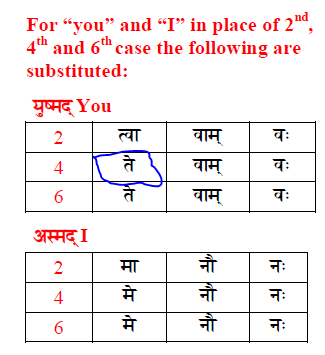
ते - to you (dative, singular) Pl see table 4

Table 1

Table 2


Table 3


Table 4


Friday, 28 November 2014

BG 1.4-6 'A śloka a day' #SAH #SanskritGrammar

Duryodhana enumerates the Pāṇḍava-allies
अत्र शूरा महेष्वासा भीमार्जुनसमा युधि |
युयुधानो विराटश् च द्रुपदश् च महारथः ||4||
धृष्टकेतुश् चेकितानः काशिराजश् च वीर्यवान् |
पुरुजित् कुन्तिभोजश् च शैब्यश् च नरपुंगवः ||5||
युधामन्युश् च विक्रान्त उत्तमौजाश् च वीर्यवान् |
सौभद्रो द्रौपदेयाश् च सर्व एव महारथाः ||6||

atra śūrā maheṣvāsā bhīmārjunasamā yudhi |
yuyudhāno virāṭaś ca drupadaś ca mahārathaḥ ||4||
dhṛṣṭaketuś cekitānaḥ kāśirājaś ca vīryavān |
purujit kuntibhojaś ca śaibyaś ca narapuṃgavaḥ ||5||
yudhāmanyuś ca vikrānta uttamaujāś ca vīryavān |
saubhadro draupadeyāś ca sarva eva mahārathāḥ ||6||


Here are heroes, mighty archers, equal in battle to Bhīma and Arjuna; Yuyudhāna and  Virāṭa, and Drupada the great warrior. Dhṛṣṭaketu, Cekitāna, and the brave king of  Kāśi, Purujit, Kuntibhoja and Śaibya, a bull among men; mighty Yudhāmanyu, the brave Uttamaujā, the son of Subhadrā and the sons of Draupadī, all indeed great warriors.

अत्र here
शूराः heroes (masc, nom, plural)
महेष्वासाः mighty archers (masc, nom, plural from महा+इषु+√अस् (4P) great 'throwers' of arrows) 
भीमार्जुनसमाः equal to Bhīma and Arjuna (masc, nom, plural, ajd) 
युधि in battle (locative, fem, sing)
युयुधानः Name of a Pāṇḍava-ally (masc, nom, sing) 
विराटः Name of a Pāṇḍava-ally (masc, nom, sing)
च and
द्रुपदः  Name of a Pāṇḍava-ally (masc, nom, sing)
च (connector of noun and adjective)
महारथः epithet/adj of Drupada
धृष्टकेतुः Name of a Pāṇḍava-ally (masc, nom, sing)
चेकितानः Name of a Pāṇḍava-ally (masc, nom, sing)
काशिराजः Name of a Pāṇḍava-ally (masc, nom, sing)
च (connector of noun and adjective)
वीर्यवान् the brave
पुरुजित् Name of a Pāṇḍava-ally (masc, nom, sing)
कुन्तिभोजः Name of a Pāṇḍava-ally (masc, nom, sing)
च and 
शैब्यः Name of a Pāṇḍava-ally (masc, nom, sing) 
च (connector of noun and adjective)
नरपुंगवः bull among men (adj)
युधामन्युः Name of a Pāṇḍava-ally (masc, nom, sing)
च and
विक्रान्तः Name of a Pāṇḍava-ally (masc, nom, sing)
उत्तमौजः Name of a Pāṇḍava-ally (masc, nom, sing)
च (connector of noun and adjective)
वीर्यवान् the brave
सौभद्रः Abhimanyu
द्रौपदेयाः sons of Draupadī
च and
सर्व all (सर्वे in sandhi)
एव indeed (often used as a metrical or rhythmic filler)
महारथाः great warriors (masc, nom, plural)

Thursday, 27 November 2014

BG 1.3 'A śloka a day' #SAH #Grammar


पश्यैतां पाण्डुपुत्राणाम् आचार्य महतीं चमूम् |
व्यूढां द्रुपदपुत्रेण तव शिष्येण धीमता ||3||

paśyaitāṃ pāṇḍuputrāṇām ācārya mahatīṃ camūm |
vyūḍhāṃ drupadaputreṇa tava śiṣyeṇa dhīmatā ||3||


Behold, O teacher, this great army of the sons of Pāṇḍu, arrayed [in battle formation] by your wise student, the son of Drupada 

आचार्य ācārya O teacher (vocative; note no visarga)
पश्यैतां paśyaitāṃ (पश्य एताम्)  
पश्य Look (at), perceive; (2nd person, imperative, active √paś) 
एताम्  this (fem, acc, singular - refers to the army)
पाण्डुपुत्राणाम् pāṇḍuputrāṇām of the sons of Pāṇḍu (masc, genitive, plural)
चमूः (fem, noun, sing)
महतीं चमूम् mahatīṃ camūm [look at the] great, mighty army (fem accusative)
व्यूढां  vyūḍhāṃ [the army] arrayed in battle formation (fem, acc, sing past passive participle vi √vah adj for  चमूः )
द्रुपदपुत्रेण  drupadaputreṇa by the son if Drupada (masc, instrumental, sing)
तव tava your (genitive, sing) 
शिष्येण  śiṣyeṇa by your student
धीमता dhīmatā [by] wise, intelligent adj. for Drupadaputra

Please note the agreement between the nouns and adjectives:
एताम् व्यूढाम् महतीम् चमूम् (feminine accusative singular)  
धीमता शिष्येण द्रुपदपुत्रेण (masculine instrumental singular)


Wednesday, 26 November 2014

Rāmāyaṇa 1.1.1-2 "A śloka a day #SAH #SanskritGrammar


श्रीमद्वाल्मीकिरामायणम्
Śrīmadvālmīkirāmāyaṇam


बालकाण्डम्
Bālakāṇḍam

प्रथमः सर्गः
Prathamaḥ Sargaḥ

नारदवाक्यम्
Nāradavāykam


तपःस्वाध्यायनिरतं तपस्वी वाग्विदां वरम् 
नारदं परिपप्रच्छ वाल्मीकिर्मुनिपुन्गवम्

को न्वस्मिन् सांप्रतं लोके गुणवान् कश्च वीर्यवान्
धर्मज्ञश्च कृतज्ञश्च सत्यवाक्यो दृढव्रतः

tapaḥsvādhyāyanirataṃ tapasvī vāgvidāṃ varam

nāradaṃ paripapraccha vālmīkir munipuṃgavam

ko nv asmin sāmprataṃ loke guṇavān kaś ca vīryavān

dharmajñaś ca kṛtajñaś ca satyavākyo dṛḍhavrataḥ


[The hermit] Vālmīki, dedicated to austerities, asked Nārada, the best of munis, the best among experts skilled in speech [and] devoted to austerity and study [of the Vedas]:  

"Who is in this present world endowed with virtues? Who is brave, knows the dharma, is grateful, speaks the truth, and is firm in his vows?" 


My big problem (as a Hindi speaker) when I first read the first verse - I couldn't tell who was asking whom the question. And which descriptions went with which 'muni' Then I was given a small (actually, very big) hint. Work out what is in the nominative case (प्रथमा विभक्ति) and what is in the accusative case (द्वितीय). That is the key. In nominative are two words - tapasvi and Vālmīki. He is the doer/asker. In the accusative is Nārada, the one being asked, and all qualifiers in accusative are connected to him.  

तपःस्वाध्यायनिरतं - [to him] who is devoted to [Vedic] studies and [religious] austerities
तपः austerity, discipline (masc., nom., sing.)
स्वाध्यायः recitation/self-study (masc., nom., sing)
निरतं engaged in, devoted to, pleased by (accusative past participle [ni + √ram] as adjective)
तपस्वी  ascetic (masc., nom., sing)
वाग्विदाम् of [those] skilled in speech (genitive, masc. plural) stem = वाग्वित् 
वरम् best (accusative adj., agreeing with Nāradam)*
नारदं - (accusative, because otherwise, being a masculine, it would have been नारदः I cannot stress this enough)
परिपप्रच्छ = परि + पप्रच्छ  asked about = (perfect of √प्रछ् to ask; perfect, 3rd person, sing. agreeing with Vālmīki) [Pari = prefix = about.]


वाल्मीकिर्मुनिपुन्गवम् (वाल्मीकिः+मुनिपुङ्गवम्)
वाल्मीकिः Valmīki, (masc, nom, the doer/asker)
मुनिपुङ्गवम् to the bull [best] among munis (this is in accusative so it refers to Nārada NOT to  Valmīki. If it referred to Valmīki, the ending would be मुनिपुंगवः masc. nom. with a visarga, since puṃgava is masc.)
को who? (masc, nominative, sing, This is कः in sandhi.  
नु now then/certainly (avyaya/indeclinable) 
अस्मिन् in this (locative, masc.,sing., of idam 'this') nu+asmin in sandhi become  न्वस्मिन् 
सांप्रतं  now, at present (adverb) 
लोके  in this world ( locative, neut, sing.)
गुणवान्  endowed with/possessed of virtues, [good] qualities (masc., nom, sing)
कश्च and who? (कः in sandhi with च)
वीर्यवान् endowed with heroic qualities (masc, nom, sing)
धर्मज्ञश्च (धर्मज्ञः+च) Knower of dharma (masc., nom., sing) 
कृतज्ञश्च (कृतज्ञः+च) grateful/correct in conduct (masc, nom, sing) 
सत्यवाक्यो (सत्य+वाक्यः) Whose speech is true 
दृढव्रतः He whose vow is firm


Monday, 24 November 2014

BG 1.2 'A śloka a day' #SAH #SanskritGrammar

Saṃjaya receiving divyadṛṣṭi to relay the battle account

संजय उवाच

दृष्ट्वा तु पाण्डवानीकं व्यूढं दुर्योधनस् तदा |

आचार्यम् उपसंगम्य राजा वचनम् अब्रवीत् ||2||

saṃjaya uvāca

dṛṣṭvā tu pāṇḍavānīkaṃ vyūḍhaṃ duryodhanas tadā |

ācāryam upasaṃgamya rājā vacanam abravīt ||2||

Saṃjaya spoke:

Seeing, indeed, the army of the Pāṇḍavas, drawn up in battle, [King] Duryodhana approaching his teacher, said these words.

संजय saṃjaya (masc, nom, sing. like रामः visarga dropped before उ of उवाच Sandhi rules)

उवाच uvāca  [He/she/it] said (3rd sing. perfect, active, √vac  see table 2) 
दृष्ट्वा dṛṣṭvā having seen/seeing (gerund from √dṛś)
तु  tu indeed, surely (indeclinable)
पाण्डवानीकं pāṇḍavānīkaṃ army of the pāṇḍavas (masc, acc, sing, tatpuruṣa compound)
व्यूढं vyūḍhaṃ drawn up in battle, arrayed (masc, acc, sing. passive past participle from vi+√uh)
दुर्योधनः  duryodhanaḥ (masc, nom, singular like रामः note that before त of तदा, the visarga becomes a स्)
तदा tadā then, at that time
आचार्यम् ācāryam [to the] teacher [Droṇa] (noun, masc, acc, sing) 
उपसंगम्य upasaṃgamya having approached/approaching (gerund from upa+sam+√gam)
राजा rājā the royal person [duryodhanaḥ] (masc, nom, sing)
वचनम् vacanam word, speech (noun, neut. acc. sing.)
अब्रवीत् abravīt [he/she/it] spoke/said (3rd sing. *imperfect*, active from √brū see Table 1)

 Table 1 Conjugation:√brū (Class2 parasmai pada) present & *imperfect*

Table 2 Conjugation of √vac (Class 3 PP) perfect:


Sunday, 23 November 2014

BG 1.1 'A śloka a day' #SAH #SanskritGrammar

धृतराष्ट्र उवाच
धर्मक्षेत्रे कुरुक्षेत्रे समवेता युयुत्सवः |
मामकाः पाण्डवाश् चैव किम् अकुर्वत संजय ||1||

dhṛtarāṣṭra uvāca:

dharma-kṣetre kuru-kṣetre samavetā yuyutsavaḥ |
māmakāḥ pāṇḍavāś caiva kim akurvata saṃjaya ||1||

Dhṛtarāṣṭra said:


धृतराष्ट्रः dhṛtarāṣṭra (masc, nom, singular like रामः* visarga dropped before उ of उवाच sandhi rules)
उवाच uvāca (3rd singular perfect active √vac) [He/she/it] said
धर्म-क्षेत्रे dharma-kṣetre (n, loc. sg) in/on the field of dharma (genitive tatpuruṣa cpd)
कुरु-क्षेत्रे  kuru-kṣetre (n, loc. sg) in/on the field of kuru (genitive tatpuruṣa cpd)
समवेताः  samavetāḥ  (m nom pl ppp sam ava √i) come together, assembled. visarga is dropped before  य of युयुत्सवः  sandhi rules)
युयुत्सवः (m nom pl desiderative adj √yudh) desiring to fight. Battle hungry
मामकाः māmakāḥ  (m nom pl) mine, my (visarga stays before पाण्डवाः sandhi rules)
पाण्डवाः pāṇḍavāḥ (m nom pl) the sons of Pāṇḍu (visarga becomes श् before succeeding च)
चैव caiva (च +एव) च and  एव indeed; used as a metric filler
किम् kim (interrogative) what; note the म् assimilates with the अ of अकुर्वत and becomes म and not an anusvāra)
अकुर्वत akurvata  (3rd plural imperfect ĀP √kṛ) [they] did
संजय! Saṃjaya (Vocative case, hence no visarga. Top tip to locate direct speech!)

* Please refer to this table to understand the case विभक्ति of the substantives that end with 'अ/a'  like क्षेत्र, etc.
Table generated using http://sanskrit.inria.fr/