Thursday, 31 January 2013

Patañjali's yogasūtra 1:18 Asamprajñātaḥ Samādhi


{1:18}

विरामप्रत्ययाभ्यासपूर्वः संस्कारशेषो Sन्यः 


virāmapratyayābhyāsapūrva saskāraśeo ’nya

विराम प्रत्यय अभ्यास पूर्वः संस्कार शेषः अन्यः 

I.K Tamini:

The remnant impression [left in the mind] after previous practice [and] on cessation of the content in the mind, is the other (type of samādhi)

The Bihar School:

The other (anya) samādhi is preceded by continued practice (abhyāsa) of stopping the content of the mind. In it the mind remains in the form of traces.

Trevor Leggett's translating Śankarācarya’s commentary:

The other [samādhi] follows on practice of the idea of stopping and consists of saskāra-s alone.


विराम -pause, stop, end; masc noun
प्रत्यय - idea, concept, content of mind; masc noun
अभ्यास - exercise, practice;drill; masc noun
पूर्वः - पूर्व as an adjective means initial, earlier, prior. Hhere, the visarga indicates it is being used as masc. noun, a kinship term like forefather or ancestor. Almost like the three that have gone before beget something, which in this case is संस्कार. It's a subtle difference. Even the adjective works, but use of the noun establishes a deeper link - 'born of'. 

संस्कार - impressions in the mind of deeds and activities performed in a former state of existence; masc noun.
शेषः - that which remains or is left behind; masc/neuter noun
अन्यः - the other, another. The fact that this adjective has a visarga clearly indicates that it refers to a masc noun, which is [another] samādhi.

In 1:17, we learned about samprajñātaḥ samādhi which is a state of mind accompanied by reasoning, reflection, bliss and a sense of individuality. All of these indicate some activity or content in the mind. Hence we can collectively call them प्रत्ययाः  When these contents are stopped. paused, ended, we have a state new state of samādhi which is called the 'other' i.e. not samprajñātaḥ therefore - asamprajñātaḥ.

I cannot stress enough that this is only a grammatically analysis and a translation based on commentaries by yogic experts. In no way does it intend to 'teach' you how to achieve samādhi. If at all, the only aim is to arouse your curiosity to find out more. Yoga has been a living tradition for longer than written History, and is transmitted through an unbroken chain of living gurus. You must learn from one such adept.

Tuesday, 29 January 2013

Bāṇabhatta: A passage from Harshacarita Dvitya ucchvāsaḥ

abhatta was a poet in the court of the 7th century King Haravardhana of Kannauj. He is considered one of the brightest stars in the galaxy of Sanskrit Kāvya and is best known for his prose work ‘Haracarita’ a biography  of the king; and Kādambari, which is one of the world’s earliest novels in the world.

Here I translate Bāa’s description of King Hara when he returns to the court after a hiatus. What is unique about this text is it is the first time the grandeur and royal grace of the king is not glorified by comparing him to mythological heroes and gods. Rather, Hara transcends them in his practice of the ‘rājadharma’. The faults of the gods are detailed to show what a good king he is. I must say I was pleasantly surprised, and believe it to be a testimony to the tolerance of 7th century Hindus. The translation starts from  "so 'yam..." at the end of line 1 and ends at śya:


The basic sentence is: 'This was [the] Lord, [the] king, Haraḥ.' And between the beginning and end of the sentence are a series of descriptions. He is: 


सुजन्मा - well born
गृहीतनामा - whose name is well received
तेजसां राशिः - a collection of splendour, radiance
चतुरुदधि केदार कुटुम्बी - [like] a farmer who's field is the [world with] four oceans
भोक्ता ब्रह्मस्तंभ फलस्य - enjoy-er of the fruit of all creation
सकलादिराजचरितजयज्येष्ठ मल्लो  - wrestler [who has bested] the doings [record] of the earliest kings (like Manu and Prithu) 
With/By him (etena) the earth was indeed (khalu) possessor of a good king (rājanvati)

The next basic sentence is: His glory is not... (न अस्य श्रियः), and in between नास्य and श्रियः we have a list of thing that his glory is not:

His childhood actions are not anti-dharma (vipravirodhini) like those of Krishna (hareriva
Nor like Shiva (paṣupateriva) whose state of being a mighty Lord was the cause of the distress (udvega) of Dakṣa 
Nor are words/reports [of his actions] like those of Indra [who was guilty of] killing a tribesman (might also refer to him battling a mountain, as gotra means mountain also)
Nor is he fond of wielding the dana [of punishment] the way Yama is
Nor does he guard his treasure(s) with fearsome monster[s] (nistrinśagrāh) like Varuṇa
Nor is an assembly with him fruitless as it is with Kubera
Nor is his philosophy (pl.) [about] void[ness] like that of Buddha [jina]
Nor is his splendour marked,  blotted like that of the moon.

If you wish to read this masterpiece of Sanskrit prose, you can buy it here:
http://books.google.co.uk/books/about/The_Harshacharita.html?id=91yI040vbT8C&redir_esc=y (links are on the side)

If you are in India you can also buy it from mlbd.com and Flipkart.

Monday, 28 January 2013

Building words from verbal roots: Primary Suffixes (कृत् प्रत्यय) 2

क्विप्, अ, , अन, अ:, ति, मन्, त्र,  तृ, अक  

सेव् (1A) to serve => सेवा (f) service 


कृत्  प्रत्यय  'आ'  


A number of roots for feminine action nouns with the suffix आ। For instance:

सेव् (1A) to serve => सेवा (f) service 
भाष् (1A) to speak => भाषा (f) speech, language
क्रीद् (1U)  to play => क्रीडा game, sport  
चिन्त्(10P) to think  => चिन्ता (f) thought, anxiety


वि+भूष् (1P) adorn  =>विभूषणम् ornament, adorning


कृत्  प्रत्यय  'अन' 

The suffix अन is one of the most important and productive suffixes. Like अ it forms action nouns freely from many roots, but unlike अ which forms mostly masculine nouns, this suffix forms mostly neuter nouns, a good way to recognise which is - the nominative singular will end in म् rather than a visarga. The root vowel often [but not always] takes गुण before it. 

गम् (1P) to go => गमनम् going 
हन् (2P) to kill => हनहम् killing 
दा (3P) to give => दानम्  giving, gift
भुज् (7P) to eat/enjoy => भोजनम् enjoyment, food
वद् (1P) to speak => वदनम् mouth, face 
वि+भूष् (1P) adorn  =>विभूषणम् ornament, adorning
स्था (1P) to stand  => स्थानम् place 
श्रु (5P) to hear  => श्रवणम् hearing
आस् (2A) to sit  => आसनम् seat, posture
वह् (1P) to carry  => वाहनम् carrying, mount, carriage


Read & Revise: Rama goes to the forest


When he obtained the permission of the King, Rama went along with the muni to the forest. There, in the forest, many rishis lived in ashrams. They always meditated and did sacrifices. During that time many demons obstructed them. To protect the munis from the demons, came Rama. Even though he was a boy, that brave [Rama] killed many demons with arrows. Wherever Rama went, [from] there the demons were scared and fled. Wherever Rama and Lakshmana saw [the] demons (there) they cut off their limbs. When all the demons were killed or departed, then Rama leaves the forest and goes to Mithila. In that country a very wise king named Janaka ruled. Janaka [had an] extremely charming daughter named Sita. The people think she is the foremost amont all women. All [the] kings thought 'I will marry Sita' Therefore they assembled in Mithila. 

Sunday, 27 January 2013

Patañjali's yogasūtra 1:17 samprajñātaḥ samādhi


The Yoga Publications Trust, Mungher, Bihar begins it's commentary on Patañjali’s Yogasūtras with a delightful story in which a heated debate is going on between some pundits on the definition and correspondence of the types, or stages of samādhi. Of savitarka, nirvitarka, nirbīja, sabīja saṃprajñatā asaṃprajñatā and so on. The pundits start yelling at each other and nearly come to blows. Just then a fat, contented cow ambles into the lawn, sits behind them and suddenly bellows M-o-o-o-o-o-o-o- making them jump in fright. The author says that the moo-ing of the cow was the most intelligent contribution to the debate - because Patañjali’s Yogasūtras are meant to be experienced rather than intellectualised. 

I.K. Taimini adds another insight. He says, reading Patañjali’s Yogasūtras is like holding a paper map in your hand. Everything is marked out - the hills, the rivers, the boundaries, the distances - but till you visit that land and see it for yourself, you'll never know what it's really like.

With this in mind, we move to one of the most complex couple of sūtras, regarding the nature of samādhi.Difficult in themselves, and difficult because we have to understand them without the support of key yogic concepts which we will only meet in Chapter 2, the Sādhanā Pāda. 


{1:17}

वितर्कविचारानन्दास्मितानुगमात् संप्रज्ञातः  


vitarkavicārānandāsmitānugamāt samprajñātaḥ

वितर्क विचार आनन्द अस्मिता अनुगमात् संप्रज्ञातः 

saprajñatā is [that state of mental concentration] which is accompanied by reasoning, reflection, bliss and a sense of individuality. 

वितर्क:  -  deliberation, consideration, reasoning; masc noun
विचार: -thought, idea; masculine noun 
आनन्द: - pleasure, delight, happiness; masc noun
अस्मिता - ego, sense of self; fem noun 
अनुगमात्  - going after, following, accompanying; ablative singular of अनुगम masc. noun
संप्रज्ञातः - state of samādhi ; lit. accompanied by intelligence, insight, wisdom.

Read & Revise: A troubled muni visits Daśaratha


I do apologise for all the pencil markings!! Trust it's still good to read. Please write in if you have any specific problems with the text.


Whenever Daśaratha saw his eldest son, he experienced (anubhavati) the highest joy. Rāma too was endowed with intelligence. (lit. joined with). He understood (avagachati) all the vedās. And excelled (lit. went beyond) at bowmanship (dhanuraveda). When he lifted an arrow (uddharati) the gods also trembled in heaven. Once, some muni came to Ayodhyā and said to  Daśaratha."O King! We munis are troubled by rākṣasas. You only are the protection of your subjects. If you don't send (preṣyasi) some brave [person] then we are all doomed" (lit. destroyed).Daśaratha said: " O Muni! Such demons who [can] cause ṛṣis to tremble, who is capable of killing them?" The muni said: Two such capable brave [men] are (lit. exist vartate) in Ayodhyā. Who are they, asked  Daśaratha."Your sons Rāma and Lakṣmaṇa said the brahmin. When Daśaratha heard the words of the muni, was was very unhappy. Since [a] brahmin is [a] gods amongst men, therefore even the king must do what he says. Therefore he sent his beloved sons to the forest with the muni.

Saturday, 26 January 2013

Read and Revise: Dashratha's life carries on...

Even if you read for 5-10 minutes everyday, very soon it will become second nature. Please write in if you have any queries about specific sentences or grammatical construct.

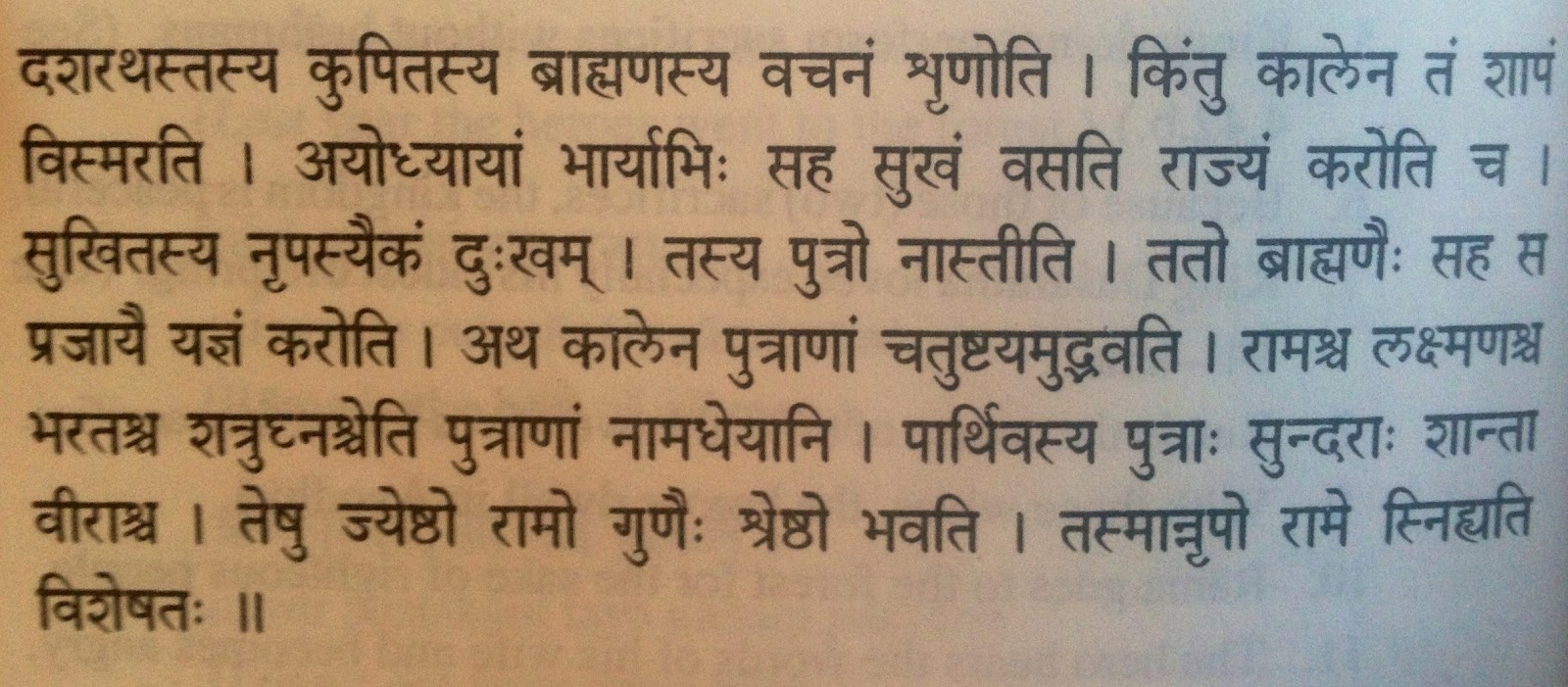
We read elsewhere about the accidental killing in the forest of the young boy by King Daśaratha. The brahmin father of the dead boy curses the king, and immolates himself on his son's pyre. Daśaratha is understandably distraught:


Daśaratha hears the the words of the angry (kupita) brahmin. But in time, he forgets that curse. He lives in Ayodhyā happily (sukham) along with his wives and rules also. The happy king had only one sadness. (lit. of the happy king there is only one sadness). He has no son. Then along with brahmins, for a child, he does a yajña. Then in time, four sons are born (udbhavati). They are named ( nāmadheya) Rāmaḥ, Lakṣmaṇaḥ, Bharataḥ and Śatrughna. the sons of the king (pārthiva) are handsome, peaceful and brave. Of them, the eldest, Rāmaḥ is the most superior in good qualities. Therefore the king loves Rāmaḥ especially.