Monday, 29 September 2014

Dharma, Artha, Kāma, Mokṣa - XXIII

Dr. Bibek Debroy
You'd imagine that as the blog host who has seen many a DAKM-s, I would not be taken by surprise by the series - but that just goes to show how little I know, really! In this post, Dr. Debroy examines the varna system from an angle I hadn't thought possible. The quest for knowledge continues, in ways we didn't even think about! Read, learn, enjoy and share your views with us. Follow Bibek on Twitter (@bibekdebroy) and/or leave a comment on the blog.

One must follow the principles of dharma in earning artha.  As we have said, dharma has multiple meanings.  Often, dharma is understood as वर्णाश्रम dharma, that of the four varnas and the four ashramas.  The four varnas mean ब्राह्मण, क्षत्रिय, वैश्य and शूद्र.  For instance, the first half of 4.13 in the Bhagavad Gita states, चातुर्वर्ण्यं मया सृष्टं गुणकर्मविभागशः “In accordance with the qualities and the deeds, the divisions of the four varnas have been created by me.”  Later, in 18.41 and subsequent shlokas, it goes on to state that the duties of brahmanas, kshastriyas, vaishyas and shudras have been divided in accordance with their nature, their strengths and their qualities.  The tasks of brahmanas are naturally driven by qualities of serenity, self-control, austerities, purity, tolerance, uprightness, knowledge and faith.  The tasks of kshatriyas are naturally driven by qualities of valour, energy, fortitude, dexterity, not running away in battle, donations and lordship.  The natural duties of vaishyas are agriculture, animal husbandry and trade.  The natural duty of a shudra is servitude.  In any society, there is a functional division in terms of who does what.  That’s specialization and division of labour.  In terms of who does what, this part of the Bhagavad Gita doesn’t clearly tell us what brahmanas and kshatriyas are supposed to do.  It is specific only for vaishyas and shudras.  But there is no dearth of texts that tell us what brahmanas and kshatriyas are supposed to do, more specifically and there is no inconsistency across them.  Manu Samhita, one of the Dharmashastra texts, is an example.[1]  In 1.88-91 we are told, brahmanas are supposed to teach, study, perform sacrifices, officiate at the sacrifices of others, give alms and receive alms.  Kshatriyas are supposed to protect people, perform sacrifices, study and donate.  Vaishyas will engage in agriculture, animal husbandry and trade, lend money, study, perform sacrifices and donate alms.  Shudras will serve the other three varnas.
Not only is the varna issue controversial, there are too many generalizations around it. Consider the issue of interest rates.  This is a quote from 8.140-142 of the Manu Samhita, as translated by G. Buhler.[2] “A money-lender may stipulate as an increase of his capital, for the interest, allowed by Vasishtha, and take monthly the eightieth part of a hundred. Or, remembering the duty of good men, he may take two in the hundred (by the month), for he who takes two in the hundred becomes not a sinner for gain. Just two in the hundred, three, four, and five (and not more), he may take as monthly interest according to the order of the castes (varna).” This seems to suggest an annual interest rate of 15%. However, it can also be 24% for brahmanas, 36% for kshatriyas, 48% for vaishyas and 60% for shudras.  The interest rate is ostensibly graded according to the varna.  Contrast this with a quote from the Artha Shastra.[3]  “An interest of apana and a quarter per month per cent is just.  Five panas per month per cent is commercial interest (vyavahariki).  Ten panas per month per cent prevails among forests.  Twenty panas per month per cent prevails among sea-traders (samudranam).”[4]  In the Sanskrit, the word dharma is used and an interest rate of 15% per year is in accordance with dharma.  As with several words in Sanskrit,व्यवहारिक can have multiple meanings.  In this context, it does mean commercial.  Hence, compared to the normal interest rate of 15%, the commercial rate of interest is 60%.  The word कान्तारग is more difficult to translate.  It does mean one who has gone to a forest, but has the nuance of someone who journeys through a forest or a wilderness.  In such cases, the interest rate is 120%.  Finally, that 240% is for those who undertake sea-voyages.  In Kautilya, there is no reference whatsoever to interest rates being linked to varna.  A journey through a forest was riskier than an ordinary commercial venture.  A sea-voyage had greater uncertainty than a journey through a forest.  The Kautilya scale was hence a risk premium added to the usual commercial rate of interest and nothing more.  Who were the people who were likely to engage in trade and undertake voyages through forests and seas?  Clearly those who engaged in trade, that is, vaishyas. Ipso facto, the interest rate, with the risk premium added, was likely to be higher for vaishyas than for brahmanas or kshatriyas.  We are not quite discussing the interest rate now.  This was more in the nature of an illustration.  There is a difference between interest rates being linked to a functional occupation and being linked to varna per se.  In generalizing about varna, this is worth bearing in mind.
Don’t start to criticize me about varna.  I have not completed everything I want to say about varna.  The varna discussion will continue.  Based on earlier feedback, I have decided to keep each blog short.


[1] It is difficult to date this precisely.  Anything between 1250 BCE and 200 BCE is possible, with something like 500 BCE as a reasonably final form.
[3] As with several other texts, there are problems in dating Kautilya’s Artha Shastra. There is a discussion in Thomas R. Trautmann, Arthashastra, The Science of Wealth, Allen Lane, 2012.  150 CE is a reasonable date.
[4] This is the translation by R. Shamasastry, Government Press, Bangalore, 1915, The Arthashastra of Kautilya.  This section is from 3.11.01.

Saturday, 20 September 2014

Dharma, Artha, Kāma, Mokṣa - XXII


Dr. Bibek Debroy
Dharma, Artha, Kāma, Mokṣa returns in a new avatar. And as becomes an avatar, it has a mission. The column will feed into a book planned by Bibek Debroy. He invites you to be part of this process - a truly exciting opportunity. Read the columns meaningfully, share your opinions, comment, feedback. Engaging with this column makes you part of the creation of Bibek's book - a unique opportunity indeed! Interact with Bibek on Twitter @bibekdebroy and/or leave a comment on the blog.


After a break, dharma, artha, kama, moksha is back under a different garb.  But there is a background I need to explain.  I am writing a book on “artha”.  This is work in progress and these are bits and pieces from that.  Hence, two requests.  First, since this work in progress, give me feedback and comments.  That will make the book better.  Second, please do not look at one DAKM in isolation.  It is a series (from the planned book) and needs to be looked at through that lens of continuity. 
कर्मण्यवाधिकारस्ते मा फलेषु कदाचन।  This is a famous shloka from the Bhagavad Gita.  “You indeed have a right to the action, never to the fruits.”  In advancing a proposition that Hinduism is concerned more about the world hereafter and is concerned relatively less with material prosperity in the present world, this shloka is also cited.[1]  If the fruits are irrelevant, why should I be motivated to do anything?  Why should I try to improve my material prosperity?  Let me instead focus on the world hereafter.  It so happens that this is not a shloka from the Bhagavad Gita, it is half of a shloka, from shloka 2.47, the 47th shloka in the 2nd Chapter.  The remaining half of the shloka, often not quoted, is as follows.  मा कर्मफलहेतुर्भूर्मा ते सङ्गः अस्त्वकर्मणि।  “Never should action originate because of the fruits.  Nor should you be attached to lack of action.”  With both halves of the shloka taken together, one forms a slightly different impression.  In discussing Hinduism, with its immensely huge corpus, and attitudes of Hinduism towards specific topics, one must therefore be careful in quoting selectively.  What’s the point of quoting half a shloka, without considering the rest of the Bhagavad Gita?  How can one quote from a text, ignoring the context of who it was composed for and by whom?  Not to speak of issues about when it was composed.
            The word वर्ग (varga) means category or class.  Used in the sense of an objective or purpose, the three objectives or vargas of human existence are धर्म (dharma), अर्थ (artha) and काम (kama). These are पुरूषार्थs (purusharthas), the objectives of human exertion.  Strictly speaking, there are four purusharthas, not three - the fourth being मोक्ष (moksha).  Moksha can be translated as emancipation, liberation, freedom, release.  There are eighteen पर्वs (parvas) in the Mahabharata.  In this context, the word parva means part or section.  One of the longest of these 18 parvas is Shanti Parva, the section that is about peace.  Bhishma hasn’t yet died.  He is lying down on the bed of arrows and Shanti Parva, and the subsequent Anushasana Parva, constitute his teachings to Yudhishthira and his brothers.  A sub-section in Shanti Parva is titled Moksha-Dharma-Parva, Chapters 168-353 in the Critical Edition.[2]  

In this sub-section, there is a conversation between Krishna Dvaipayana Vedavyasa and his son, Shuka, where Shuka asks his father and preceptor about moksha.  This is what Vedavyasa says. “A being is bound down through deeds and is freed through knowledge..…However, a person who obtains knowledge reaches the spot where there is no reason to grieve.  Once one goes there, one does not die.  Once one goes there, one is not born. Once one goes there, one does not decay.  Once one goes there, one does not increase.”  In Sanskrit, the last two sentences are as follows. यत्र गत्वा न म्रियते यत्र गत्वा न जायते। न जीर्यते यत्र गत्वा यत्र गत्वा न वर्धते।[3] This is the sense in which moksha is usually understood, a state where an individual is freed from the cycle and bondage of death and rebirth and karma.  Indeed, this is precisely what happens to Shuka. He is liberated and emancipated in that sense.  

But if one reads the Mahabharata, is that the sense in which the word moksha is used?[4]  The Mahabharata was not only about exceptional people like Shuka.  It was also about people concerned with this world, people who had to deal with dharma, artha and kama, not only about moksha, interpreted as liberation from the cycle of life.  The Bhagavad Gita has 18 chapters and the titles of each of these chapters is qualified by the use of the word योग (yoga).[5]  Only one of these titles uses the word moksha and this is the 18th chapter, titledमोक्षसंन्यासयोग (moksha-sannyasa-yoga).  If one reads through this entire chapter, there is not a single instance of the word moksha being used in the Shuka sense.  Instead, the entire argument is about detachment, even when one is engaged in dharma, artha and kama.  Without deviating from the subject and going off on a tangent on a discussion of moksha, there is a simple point being made. Who has said that Hinduism is about the other-worldly pursuit of moksha in a Shuka sense?  That’s a selective and subjective reading of some texts.  It isn’t a proposition that should be advanced as a sweeping generalization.
            What about dharma, artha and kama?  Kama refers to desire, not necessarily to sexual desire alone.  Vatsayana’s Kama Sutra, one in a long line of works on kama, is illustrative.  It is often understood to be a documentation of sexual positions.  Yet, sexual positions account for only one of its seven major segments.  In Chapter 3, there is a reference to 64 kinds of arts an accomplished maiden should be familiar with.  Here is a listing of the 64. This has little to do with sexual positions or even sex and probably has more to do with artha.  That’s the reason it is worth giving the listing.

 Since this has little to do with the main topic of discussion, this listing is reproduced from the 1883 Richard Burton translation, though there is some minor variance with the prevalent Sanskrit text.[6]“(1) Singing; (2) Playing on musical instruments; (3) Dancing; (4) Union of dancing, singing, and playing instrumental music; (5) Writing and drawing; (6) Tattooing; (7) Arraying and adorning an idol with rice and flowers; (8) Spreading and arranging beds or couches of flowers, or flowers upon the ground; (9) Colouring the teeth, garments, hair, nails and bodies, i.e. staining, dyeing, colouring and painting the same; (10) Fixing stained glass into a floor; (11) The art of making beds, and spreading out carpets and cushions for reclining; (12) Playing on musical glasses filled with water; (13) Storing and accumulating water in aqueducts, cisterns and reservoirs; (14) Picture making, trimming and decorating; (15) Stringing of rosaries, necklaces, garlands and wreaths; (16) Binding of turbans and chaplets, and making crests and top-knots of flowers; (17) Scenic representations, stage playing Art of making ear ornaments Art of preparing perfumes and odours; (18) Proper disposition of jewels and decorations, and adornment in dress; (19) Magic or sorcery; (20) Quickness of hand or manual skill; (21) Culinary art, i.e. cooking and cookery; (22) Making lemonades, sherbets, acidulated drinks, and spirituous extracts with proper flavour and colour; (23) Tailor's work and sewing; (24) Making parrots, flowers, tufts, tassels, bunches, bosses, knobs, etc., out of yarn or thread; (25) Solution of riddles, enigmas, covert speeches, verbal puzzles and enigmatical questions; (26) A game, which consisted in repeating verses, and as one person finished, another person had to commence at once, repeating another verse, beginning with the same letter with which the last speaker's verse ended, whoever failed to repeat was considered to have lost, and to be subject to pay a forfeit or stake of some kind; (27) The art of mimicry or imitation; (28) Reading, including chanting and intoning; (29) Study of sentences difficult to pronounce. It is played as a game chiefly by women and children and consists of a difficult sentence being given, and when repeated quickly, the words are often transposed or badly pronounced; (30) Practice with sword, single stick, quarter staff and bow and arrow; (31) Drawing inferences, reasoning or inferring; (32) Carpentry, or the work of a carpenter; (33) Architecture, or the art of building; (34) Knowledge about gold and silver coins, and jewels and gems; (35) Chemistry and mineralogy; (36) Colouring jewels, gems and beads; (37) Knowledge of mines and quarries; (38) Gardening; knowledge of treating the diseases of trees and plants, of nourishing them, and determining their ages; (39) Art of cock fighting,
quail fighting and ram fighting; (40) Art of teaching parrots and starlings to speak; (41) Art of applying perfumed ointments to the body, and of dressing the hair with unguents and perfumes and braiding it; (42) The art of understanding writing in cypher, and the writing of words in a peculiar way; (43) The art of speaking by changing the forms of words. It is of various kinds. Some speak by changing the beginning and end of words, others by adding unnecessary letters between every syllable of a word, and so on; (44) Knowledge of language and of the vernacular dialects; (45) Art of making flower carriages; (46) Art of framing mystical diagrams, of addressing spells and charms, and binding armlets; (47) Mental exercises, such as completing stanzas or verses on receiving a part of them; or supplying one, two or three lines when the remaining lines are given indiscriminately from different verses, so as to make the whole an entire verse with regard to its meaning; or arranging the words of a verse written irregularly by separating the vowels from the consonants, or leaving them out altogether; or putting into verse or prose sentences represented by signs or symbols. There are many other such exercises; (48) Composing poems; (49) Knowledge of dictionaries and vocabularies; (50) Knowledge of ways of changing and disguising the appearance of persons; (51) Knowledge of the art of changing the appearance of things, such as making cotton to appear as silk, coarse and common things to appear as fine and good; (52) Various ways of gambling; (53) Art of obtaining possession of the property of others by means of mantras or incantations; (54) Skill in youthful sports: (55) Knowledge of the rules of society, and of how to pay respect and compliments to others; (56) Knowledge of the art of war, of arms, of armies, etc; (57) Knowledge of gymnastics; (58) Art of knowing the character of a man from his features; (59) Knowledge of scanning or constructing verses; (60) Arithmetical recreations; (61) Making artificial flowers: (62) Making figures and images in clay.”
Dating texts is always difficult and so far, we haven’t said anything about time-lines. Vatsayana’s Kama Sutra could have been anywhere between 400 BCE and 200 CE, though there were similar texts of an earlier vintage.  To return to the point, kama is about the senses, not exclusively about sex.  Nor does dharma necessarily mean religion and should never be translated as religion.  In different contexts, dharma can mean good conduct, jurisprudence and rule of law and customary practice.  It can also mean the metaphysical.  Of the three purusharthas, artha is the easiest to pin down.  It means material prosperity and wealth.


[1] Since a broader point is being made, there is no need to specifically reference such mentions.


[2] All references to the Mahabharata are to the Critical Edition.  The Critical Edition was published by the Bhandarkar Oriental Research Institute, Poona, between 1933 and 1966.  A soft copy of the Critical Edition is available at http://bombay.indology.info/mahabharata/statement.html.


[3] The English translation is for 12.233.11-12, while the Sanskrit is for 12.233.12.  This means 12th parva (Shanti parva), chapter 233, shlokas 11-12.  The English translation is from The Mahabharata: A Translation, Vol.9, Bibek Debroy, Penguin, 2014.


[4] This is a point also made by Chaturvedi Badrinath, The Mahabharata, An Inquiry in the Human Condition, Orient Longman, 2007.


[5] The word yoga means union, but is used in multiple senses in different contexts.


[6] By the prevalent Sanskrit text, we mean http://titus.uni-frankfurt.de/texte/etcs/ind/aind/klskt/kamasutr/kamas.htm.  This is from Chapter 3.   The Richard Burton translation is from http://www.sacred-texts.com/sex/kama/kamaint.htm.  The numbering doesn’t exist in Richard Burton.  Once numbered, we have 62, not 64.  We have also changed “muntras” to the more common mantras.

Monday, 25 August 2014

Kundalini and the Chakras

Continuing his series on Shaktism, Rajarshi Nandy moves beyond the philosophy of Shaktism to understanding the process of kundalini rising through the chakras. There are many accounts of this online (not always accurate!) and in books; but every sadhaka has his/her own experience which comes through in their writing. While this blog post is beneficial even to the casual reader, Rajarshi is sharing practical ideas with the discerning sadhaka - which he has learned the hard way from his own sadhana. If you have a query, you can leave a comment, and/or follow Rajarshi via Twitter @TheRajarshi 


Now we have seen in the previous article a brief and psychological idea of what Kundalini Shakti practically stands for. The next important aspect of the journey related to the traditional concept of Kundalini passing through the various chakras inside the body. There are many Tantric diagrams depicting the movement of Kundalini through these various chakras as well as the shape and nature of each of them.

But before all that, what exactly are the Chakras? A reasonable misconception to be avoided is the idea that these chakras are present inside the physical human body. They are not. Their relevance is with respect to the astral body – or sukshma sharira, though they may have some correspondence with some areas in the physical body. In Yogic terminology every human being has three bodies overlapping. The physical body – sthula sharira, astral body – sukshma sharira, and causal body – karana sharira. It in the second of these bodies that there is a complex system of nadis or channels of energy flow. By some accounts there are 72,000 such nadis in this astral body, of which some of the most crucial nadis pertain to the area – again not physically but astrally – inside the length of the spinal column.  And of these the most important is known as susumna nadi, the central channel through which the Kundalini Shakti must flow, once it is awakened inside the sadhaka. [It may noted in passing that even within susumna there are also subdivision of nadis, but for all practical purposes we need not explore those depths currently.]

When a set of these 72,000 nadis converge at different points along the axis of the susumna, they result in centers of psychological functioning which the texts refer to as the chakras. Each chakra has its own unique iconographic representation and its own domain.  According to most popular accounts there are six main chakras :-

Muladhara – this is the chakra at the very base of the spine while holds the physical frame together.  This chakra is related to a sense of structure and ability of possession of the structure. On the negative side, this also often manifests in individuals as the sense of greedy possessiveness of material things. It must be remembered that while the actual point of muladhara is merely the focus of the psychological feeling, the effect of this chakras extends throughout the body, from head to toe. Basically, when awareness is concentrated in the muladhara, one is acutely aware of his physical existence. This is one end of the spectrum whose other end is the Sahashrar, or thousand-petalled lotus overhead, where the connection to, or sense of, the physical body becomes extremely weak. In most accounts the Devata of this chakra is Ganapati. 

It is therefore of great importance that Ganapati has to be worshiped in some way before a “safe” awakening of Kundalini is possible. In Yoga  the ganas are also both metaphorically and practically representations of the various kinds of sense inputs that are processed by the organism. So Ganapati is the Devata who has supreme control over these inputs, and as needed, can increase or decrease the sensory experiences or balance them to an optimum state which is most conducive for awakening the sleeping Kundalini shakti in the adhara – mind-body complex.  Also, equally, being at the very root of the system of nadis, worship of Ganapati can ensure a balance between the material and the spiritual realms. That is why there is no ritual worship in Hinduism which does not start with an invocation of the Lord of Ganas, without whose favor it becomes difficult if not impossible, initiate this process. There are other and more detailed areas which pertain to sadhana of Ganapati, but that is not related to the idea of Kundalini, and so will avoid those for the present.

Diagrammatically it is represented as a square with 4 petals containing 4 Sanskrit bijas. The corresponding tanmantra is of gandha (smell), the Shakti is known as Dakini. The tattwa is Prithiwi tattwa. To make Kundalini move beyond this chakra one has to outgrow the need to accumulate things, possessions, acquisitions etc. The beeja of this chakra is “lam”.

Swadhisthana – this is above the muladhara and corresponds to the area of sexual organs.  This chakras functions as the repository of desires of all kinds. But the most powerful of these is the force of lust, kama. Diagrammatically this chakra is represented by a crescent moon,  with 6 associated Sanskrit alphabets. This corresponds to the tanmatra of rasa (taste), the presiding Shakti is known as Rakini, and the tattwa is jala (water).  The devata of this chakra varies according of different texts. Some mention Brahma, others Narayana.  The beeja of this chakra is “vam”.
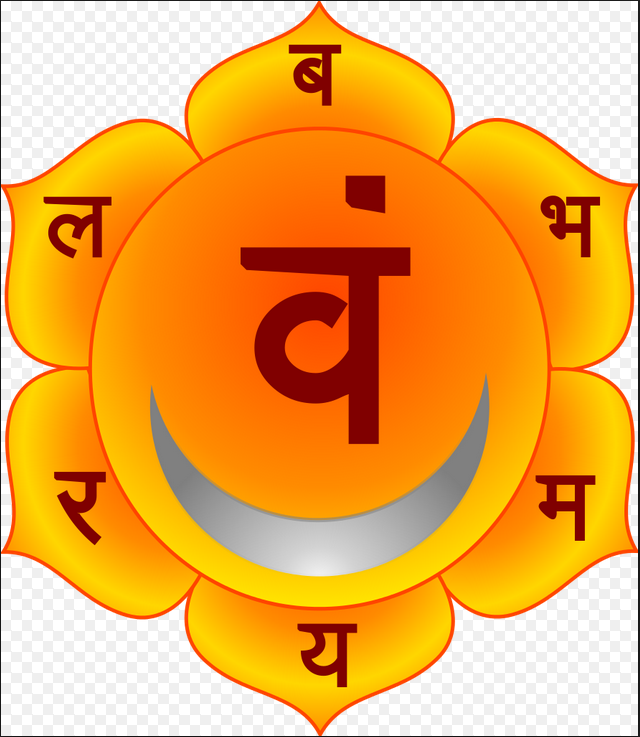
The practical importance of the swadhisthana chakra is immense, for without some control of conversion of the force of lust and desire, it is quite impossible to awaken the Kundalini Shakti beyond this chakra. When Kundalini goes beyond a chakra permanently, then there is perfect understanding and realization of the elements involved with that chakra.  So when it goes beyond Swadhisthana, it knows how, understands and surpasses the actions and repercussions of desires and lust. Unfortunately this is rarely an easy job. Therefore in most ancient traditions the sadhakas were advised strict celibacy, refraining from any contact with the world around that may provoke desires. In most paramparas these sadhana were done in seclusion. This is one of the good reasons for the same. There are other uses of it, but that comes later on in the path.

There is another vital thing to be remembered when dealing with a Kundalini process. Kundalini as I had mentioned in the previous blog is a furious force, it can blow up and accentuate any unrectified propensities already present in the inner makeup of the sadhaka, unless one has worked on them. So therefore there is a massive danger that if Kundalini gets stuck in this chakra, the individual may actually end up becoming a sexual manic or develop a serious and damaging aversion/fear towards sex.  This can also open up the individual to various influences of beings of the astral plane who feed on such energies, and then bring about a massive downfall for the seeker. While the upward journey of the Kundalini can be sublime, the downfall can be debilitating and actually brings the sadhaka to state worst than when he had started off. That when it becomes very, very important to personify the Shakti to a form of a great Devata, or a form of the Mother, or be guided and protected by a competent Guru who knows the dangers of the path.

OTOH, if Shakti really moves beyond these two chakras, the sadhaka may gain some unique abilities pertaining to the prithiwi tattwa and the jala tattwa. And in normal understanding these can appear as supernatural powers or siddhis.

Manipura – this chakra related to the area around the naval. Diagrammatically it is represented by a triangle with 10 Sanskrit alphabets. The tanmatra of rupa (form/sight) corresponds to this chakra and the tattwa of Agni (fire) relates to it. The devata of this chakra is sometimes mentioned as Vishnu and sometimes as a three-eyed form of Shiva. The Shakti of this chakra is known as Lakini.  The beeja of this chakra is “ram”.
Manipura is the center of the average human sense of I-ness. Being related to the Agni tattwa, it rules the idea of power and control, as well as assimilation. When Kundalini passes beyond this chakra, one may get an realization of the nature of power and control, or controlling anything, outgrow the need for such. The Fire in this chakra is of two kinds – Bhuta Agni and Jathra Agni. Bhuta agni is the fire of spiritual digestion, while jathara agni is the fire of physical digestion. If one increases, the other automatically decreases. Often when Kundalini is in this chakra, one of the symptoms it may manifest in the sadhaka is a complete lack of hunger, or a disproportionate increase in hunger. One can eat three to four times his normal food and yet may feel intensely hungry.  There is another dangerous effect this chakra can have in a seeker, if it starts working in a disturbed manner. Doubts. Intense doubt about everything including the whole process. It good to awaken Shakti and have various experiences, but it is more important to be able to digest and assimilate the same in the adhara.  

Among the five mukhya vayus of Yoga, samana vayu moves around the navel and is responsible for proper assimilation of the yogic experiences.  There are hatha-yogic ways in which samana vayu maybe controlled and brought into balance like the Nabhi Kriyas of traditional Kriya Yoga. But the simplest method to smoothen this difficulty is non-reactiveness, and non-judgement. Eventually as the sadhana progresses, the bhuta agni increases in the adhara and removes all blockages that may impede the sadhaka in these respects.

Anahata Chakra – this chakra is around the heart. Diagrammatically represented by a hexagon, with 12 Sanskrit alphabets associated with it. The tanmatra corresponding to this chakra is sparsha or touch, the tattwa is vayu, devata is Shankara, the Shakti is Kakini. The beeja of this chakra is “yam.”

This is the first of the higher chakras. It deals with the sense of happiness and sadness. When Kundalini Shakti enters deep within this chakra, one can hear the sound of the nada. Depending of the sadhana and the devata being worship, the exact nada may vary. Sometimes it can appear as the sound of the drumbeat of Shiva’s damaru, or the buzzing of bees, or even a drone of the Omkara, as Sri Ramakrishna had heard.  Inside this chakra lies a knot, a tangle of nadis, without opening which a full and complete experience, and therefore clear movement of Shakti above is difficult. This is known in Yogic terminology as the Vishnu Granthi and once this is opened, one can get a glimpse or a full experience of the indwelling antaraatmah, that which is beyond the mind and body and life and emotions. Often it can manifest as a small thumb sized being, or it can take the shape and form of the Devata being worshiped. A clear intuition arises in the seeker which is the birth of the inner Guru.  This is the stage where the bond between the sadhaka and the istha devata is firmly forged.

Vishuddha – This chakra lies around the throat. Diagrammatically it is represented by  a circle, with 16 petals which contain all the vowels of Sanskrit. The devata is Maheshwara, the Shakti is Shakini, the
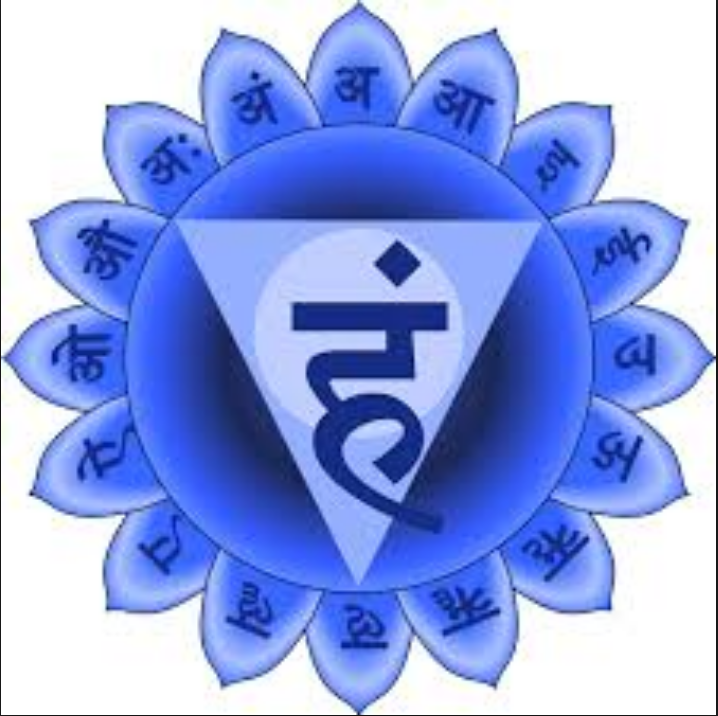

tanmatra is shabda (hearing), the tattwa is Akasha. The beeja of this chakra is “ham”. In the normal condition this chakra represents the externalized mind and the ability to speak, therefore the importance of placing all the vowels in this chakra. But when Kundalini passes through this completely and purifies the chakra, one enters a state where any mundane speech becomes impossible. Nothing other than spiritual discussions attracts the sadhaka.  Lying becomes an impossibility. A authority over words and language, poesy etc can come to the seeker if he so desires. Also and more importantly, as the Akasha Tattwa predominates in the sadhaka he will gain a capacity for harmonizing contrary ideas easily. Of the panchamahabhutas, or five great elements, Akasha is the subtlest, every present and always in perfect harmony. And also the most difficult to be realize permanently.

Agya – This chakra lies at the center of the forehead. It is represented by two petals with two Sanskrit alphabets, the devata is Ardhanarishwara. Being beyond the 5 lower chakras, it is also beyond any tanmatra or tattwa.

From Agya starts the first of the really spiritual centers of consciousness. The word Agya means command. When this chakra is energized with the Kundalini Shakti in full force, the sadhaka gains an ability to give a command which will actualize for sure, as well as receive a command from something/someone higher. It is the beginning of Shunya, just the beginning, not the end by any means. Also, in the Agya one starts developing the purusha tattwa inside the mind, learn to disassociate with the ceaseless flow of thoughts in the head. This is the best chakra to understand practically the difference between Purusha and Prakriti inside a sadhaka - the silent witness nature of Purusha and the constant movement of Prakriti. It can also provide the sadhaka with an ability of a particular type of clairvoyant vision which can be quite helpful in sadhana.

To move beyond the Agya chakra and near to the Sahashrar,  the seeker has to untie the a Gordian knot known as the Rudra Granthi, in order to experience reality or Brahman. There are more nuances in this as well, but that is the subject matter of a different  essay, and not very helpful at the beginning stages of sadhana.
               *    *    *

The reasons for associating diagrams, yantras and devatas with each chakra were so that the                     process of the sadhana pertaining to each chakra can become streamlined.  Using the bija mantras of the chakras,  the tattwas, and tanmantra, a competent sadhaka can explore the full range of possibilities of each chakra. However, that main body of knowledge remains specifically hidden within paramparas, or in some cases has been lost over time through disuse. The focus today is, and maybe rightly so, about awakening the Kundalini and making is pass beyond the chakras one at a time, instead of deliberating within the astral space of the chakra.   Infact the most common idea in any Tantric worship starts with the offering of a panchopachara puja, where five things are offered to the Devata, pertaining to five tattwa which of course are symbolic way of offering the energies pertaining to the lower five chakras.        
         
Though this six system of chakras has become popular today, there are other Tantric texts which speak of various different systems of chakras, mostly more than six. Beyond Agya and upto Sahashrar is the most complex and subtle zone of spirituality, as well as the least understood area. Self effort is not sufficient but grace – Kripa – becomes extremely important in that bit of the journey. The texts of Gorakshanatha, as translated by the late Pt. Gopinath Kaviraj who was a disciple of Sri Visuddhananda Maharaj, speak of a very different system of chakras from the prevalent notion.  And then there are also a set of “secret” chakras around the head which pertain to some obscure realms of consciousness. So which one is correct? In my opinion, all of them are correct, for all of them are using a model to define a reality. Some models are more details some lesser, but that does not mean one model becomes incorrect. Infact the experience of the chakras beyond Agya is so tremendously powerful and rare, that normal human daily vocabulary may find it very difficult to describe them accurately. A great master used to mention that these chakras beyond Agya are non-existent until one creates them by forcing the Kundalini Shakti into those areas!

However, for most of us, our life invariably revolves around the trappings of these six broad chakras, of which the lowest three are the most important for almost 90% of sadhaka as well as non-sadhakas. In my humble opinion most people who awaken Kundalini generally keep toggling Shakti between the lowest three chakras – stability/acquisitiveness, sex, power and food – trying to gain some sort of foothold and balance between the purely spiritual and the grossly mundane. That’s about it. The impediments posed by these things are often sufficient to stop one from pushing the Shakti higher and experiencing the real spiritual zones. The entire journey is not the work of one day or even one lifetime, unless the individual has prepared himself well over many lives.  Moreover once Shakti truly enters the zone of Agya or beyond, it is extremely difficult to engage normally with the world around.  On one side is the pull of the Spirit, and on the other side is the gravity of the ordinary world.  It is only the rarest of rare Yogis who can enter firmly into the Spiritual world, go right upto the experience of the sahashrar and then, instead of dropping away from the cycle of existence, come back again in order to serve some universal Dharma.

One question that often comes is whether all these chakras are opened or closed in a normal human beings. It depends. There is some function of the chakras – specially the five lower chakras - in almost everyone, unless one is a vegetable, but there is a MASSIVE difference between the average functioning of the chakras and when Kundalini passes through them and purifies them.  The first is normal life, the second is Yoga!


Sunday, 17 August 2014

Ananya Vajpeyi, this is the story of my Sanskrit.

Ananya Vajpeyi’s article ‘The Story of My Sanskrit’ which appeared in The Hindu1, was brought to my notice by @RamaNewDelhi and @madversity. As the founder of an initiative that aims to popularise Sanskrit via social media, I read it with great anticipation, always on the look-out for innovative ideas to promote Sanskrit. I found much in the article it that I sympathised with. And much that I disagreed with. Fundamentally, though, I found the author still stuck in established discourse and existing pigeonholes. Her article brings nothing new or effective to the process of reviving Sanskrit. We get to read a lot about how qualified and well educated she is, but what about some concrete steps to ‘Save Sanskrit’ which her last paragraph urges her readers to do?

I do not agree with her categorisation of “liberal, secular, egalitarian, enlightened and progressive sections of our society” as the saviours of Sanskrit from the “clutches of Hindu supremacists, bigots, believers in brahmin exclusivity, misogynists, Islamophobes and a variety of other wrong-headed characters on the right whose colossal ambition to control India’s vast intellectual legacy is only matched by their abysmal ignorance of what it means and how it works.” This simplistic binary tells me if I’m not one, I am necessarily the other. Even if I were to agree with her categories, I don’t think one or the other is in a better position to ‘save Sanskrit’.  Also, with due respect, in my experience many  ‘characters on the right’ are earnestly trying to  balance the intellectual legacy rather than control it. Sandeep Balakrishna2 @sandeepweb is an example of this. I don’t share his politics, but I understand and respect what he’s trying to do in the intellectual space.

I’m fully in agreement with Ananya Vajpeyi on the ‘peculiar pains and pleasures’ of Sanskrit, its challenges and gratification. She clearly loves the language, which is why I find it odd that she needed to explain that her decision to study Sanskrit didn’t feel ‘outlandish’ or ‘counter-intuitive’. To my mind anyone wanting to study Sanskrit is perfectly natural. To her comment that the social worlds of Sanskrit engender and proliferate caste hierarchy, sexism, inequality and misogyny –  I’d like to respond by saying that Sanskrit texts are not alone in this –  most, if not all texts of a certain antiquity contain ideas that are ‘shocking to modern sensibility.’ That’s neither here nor there in the study of ancient texts, and certainly has no bearing  on the revival or saving of Sanskrit.

Having never studied Sanskrit in India, I personally have no visibility of the prejudice she says she faced from scholars. However it wouldn’t surprise me at all and it wouldn’t be an isolated incident. Kanchana Natarajan, author of ‘Vivekavidhi of Maṇḍana Miśra’ talks in the introduction of her book about how difficult it was to find a teacher willing to instruct her. Finally, after being turned down by many scholars, she found one learned Brahmin mīmāṃsaka who reluctantly agreed to teach her on the condition that classes would not be conducted on the days she was menstruating (I presume she had to tell him when 'the curse' was upon her…). It is said that Mahadevi Varma was denied permission to study Sanskrit at Benares Hindu University by Madan Mohan Malvia because she was not a brahmin (She eventually did her MA from Allahabad University in 1933). While Sukumari Bhattacharya was allegedly denied permission to study Sanskrit at Calcutta University because she was not a Hindu.3

Reviving and promoting Sanskrit

When I first started #SanskritAppreciationHour on Twitter, Bibek Debroy @bibekdebroy told me if I got to a thousand followers, it would be ‘a very good number for Sanskrit.’ 5,500+ followers later, I think I’ve earned the right to talk about what it will take to save/revive/promote Sanskrit. The platform I’ve developed is consciously inclusive, gender neutral, race neutral, religion, creed and caste neutral; not to mention age neutral. It refuses to be limited or dragged down by stereotypes. Lecturers include a Punjabi housewife, a New York Jew, a Yajurvedi in Stockholm, and a brilliant and engaging science student in Bangalore. It seeks to draw, to inspire beginners – answers queries, clears doubts and at the end of every session, people are connected with someone who can guide them to a class/teacher close to where they live, whether it is in Chinchpokli or Cincinnati. This is not to say that brahminical exclusiveness is a myth, but that in as much as it does exists, it need not be a limiting factor to the teaching and revival of Sanskrit.

#SanskritAppreciationHour is innovative. From being a one ‘man’ band it now has the support of 8 guest lecturers – who keep interest levels high by using a mix of devotional, medical, and mathematical texts, kāvya, yoga, and conversational Sanskrit, verses from the epics, the purāṇas, hitopadeṣa, subhāṣitāni, riddles, jokes, even recipes from a 16th century text – you name it! We answer questions from what your child’s name means, to what a śloka you saw in a dream might signify.

We swap stories about having visions of our iṣṭa-deva/devi. Fortunately Bhakti allows all us non-brahmins to have those since the 7th century.We point out Sanskrit in your everyday life that you didn’t even realise. Like amṛtāñjana means an ointment which revives you if you are wounded or in pain, and vajradanti is a toothpaste that purportedly makes your teeth as strong as a thunderbolt. And that tela comes from being the extract of tila (sesame) although it now applies to all oils.

@hariturmalai has spun off his own #SanskritQuiz which has rapidly gained in popularity. We share links to videos and and texts. And we draw inspiration from Saṃskrita Bharati, an organisation which has taught 1.2 crore people in the last 32 years, in 2,500 Indian towns and 14 countries – never once asking what the caste or religion of a person was. Anyone, everyone is welcome to learn.  

Sanskrit carries a dark side from which you need to ‘bracket’ yourself only if you choose to address the dark side. It's just as easy to skirt it. There are enough un-prejudiced learned brahmins and Sanskritists to make this work, to revive Sanskrit. Not that I’ve ever asked, but I’m pretty sure that 95% of the guest lecturers on  #SanskritAppreciationHour are brahmins, and I haven’t seen a hint or a squeak of prejudice or refusal to teach anyone. In fact the need to teach and popularise Sanskrit is what draws us all together, even though we don’t share each other’s social or political views.

If Ananya Vajpeyi’s objective is to save, promote, revive Sanskrit, the article is woefully lacking. Of course articles like this must be written and read. But in and of themselves they are not enough. What we need is fresh ideas, innovation and action rather than words. You could be the most learned Sanskritist in the world, but if you don’t inspire and encourage learners, if you don’t teach, you are no use to the cause. No use to Sanskrit. Finally, for the record, I’m absolutely certain that forcing people/children to learn by making Sanskrit compulsory at any level will be counter-productive. Love for the language has to come from within. As my teenage sons would say - It’s time to make Sanskrit ‘cool’ and ‘hot’ at the same time – the best kind of attractive.  
2http://www.indiafacts.co.in/author/admin/
3 I have not been able to find corroborating evidence at the time of writing this blogpost for the 2nd and 3rd examples. This information was in one of the comments on Anaya Vajpeyi’s article in the online version of The Hindu.
You can read more of Ananya Vajpeyi’s work here: http://works.bepress.com/ananya_vajpeyi/
And interact with her on Twitter @Ananya_Vajpeyi